Do Posture Correction Devices Actually Work, or Do They Just Create Dependence?
Quick Answer: Posture correction devices genuinely work as short-term awareness cues — a brace or a buzzing wearable really does remind you to stop slouching. What they don’t do is build the muscle that holds posture on its own. Use one for a few weeks as a training aid, pair it with actual strengthening work, and fix your desk setup — then stop wearing it. This is general information, not medical advice.
The pitch is clean: strap it on, stand straighter, problem solved. And for the first week, it feels like it’s working.
Then you take it off, and within an hour you’re right back where you started. That gap between “feels effective” and “changed nothing” is the whole story here.

Do Posture Correctors Actually Work?
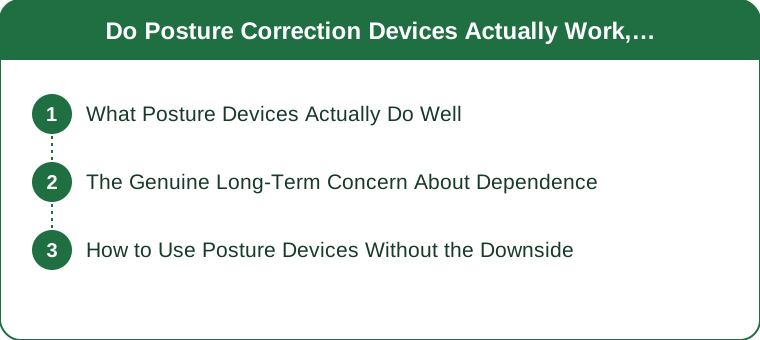
For what they genuinely do, yes — and it’s worth being fair about that before the criticism.
The awareness cue is real. A brace pulling your shoulders back or a wearable buzzing when you slump is an immediate, physical prompt. Most people slouch not because they can’t sit up but because they forget to, hundreds of times a day. An external reminder solves the forgetting.
They reveal patterns you can’t see. Most people genuinely don’t know how often they slouch, or when. A wearable that logs it gives you your first real data: it’s not “all day,” it’s 3pm onward, or it’s every call, or it’s the second hour at the laptop. That’s actionable information you weren’t going to get on your own.
Braces provide real short-term relief for some people. Physical support does reduce discomfort while it’s worn. That’s a genuine effect, even though it’s temporary — and if it gets you through a bad week, it did something useful.
So: real cue, real awareness, real short-term comfort. Three legitimate benefits. None of them is “corrects your posture.”

Do Posture Braces Cause Muscle Weakness?
This is the real concern, and the honest answer is: plausibly, with prolonged passive use — and the physiology behind the worry is sound.
Muscles strengthen by working. Your deep neck flexors, mid-traps, rhomboids, and core hold your posture. If a brace does the holding, those muscles do less. Physical therapy literature raises a consistent concern that extended reliance on external support without accompanying active strengthening can lead to relative deconditioning of the exact muscles the brace substituted for.
The device treats the symptom, not the cause. Habitual slouching usually has a specific origin: a monitor 6 inches too low, a chair with no lumbar support, a laptop on a couch, or simply weak upper-back endurance. A brace corrects the visible result while leaving every one of those causes intact.
The reversion test tells you everything. If posture snaps back within an hour of taking the device off, the device was managing the pattern, not correcting it. That’s a widely reported experience, and it’s the clearest evidence that nothing structural changed.
How much evidence is there, really? Less than the marketing implies in both directions. Studies on posture devices are generally small and short, they mostly measure posture while the device is worn, and long-term follow-up is thin. Nobody has strong data showing a brace produces lasting change — and nobody has strong data showing a few weeks of use causes harm either. Treat this as a reasonable inference from physiology, not proven fact.
5 Mistakes Everyone Makes With Posture Devices
- Wearing it all day, indefinitely. This is the one that turns a training aid into a crutch. If it’s been on your body every day for six months, it’s furniture now.
- Buying the device instead of fixing the desk. No wearable compensates for a monitor at chest height. Screen top at eye level, elbows near 90 degrees, feet flat — that’s free, and it removes the reason you’re slouching.
- Skipping the strengthening. The device gives you the cue; only exercise gives you the capacity. Rows, face pulls, prone Y-T-Ws, and simple chin tucks, a few times a week, are what actually change the baseline.
- Never testing without it. If you never take it off, you have no idea whether anything improved. The removal test is the progress report.
- Cranking it too tight. More tension does not mean faster results. An overtightened brace restricts breathing and can leave you sore in places that had nothing wrong with them.
How Should You Use One Without the Downside?
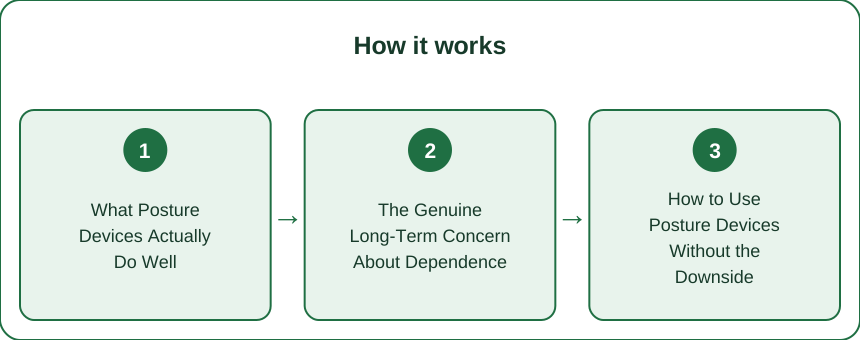
Treat it as a temporary training wheel, and pair it with the work it can’t do:
- Set an end date before you start. Two to six weeks. Put it in your calendar. A device without an expiry date becomes a permanent accessory by default.
- Wear it in short blocks, not all day — 30 to 60 minutes during the hours you actually slouch (usually afternoons). The point is calibration, not support.
- Strengthen actively at least three times a week. Upper-back rows and pulling movements, plus core work. This is the part that produces lasting change, and it’s non-negotiable.
- Fix the setup on day one. Monitor height, chair support, and a reason to stand up every 45 minutes.
- Test without it weekly. Take it off for a full day and pay attention. Improvement means it’s working; no change means the plan needs the strengthening, not a better brace.
When to see a professional: if you have pain rather than just poor posture, numbness or tingling in your arms or hands, a visible structural curve, or posture that hasn’t changed after a couple of months of honest effort, see a physical therapist or doctor. They’ll assess whether the issue is habit, weakness, mobility, or something structural — and those four need genuinely different treatment. This is general information, not medical advice.
FAQ
How long should you wear a posture corrector each day?
Short blocks — roughly 30 to 60 minutes during the times you slouch most — rather than continuously. Use it as an awareness cue for a defined period of a few weeks, not as all-day support.
Do posture correctors fix rounded shoulders permanently?
Not on their own. They cue the position while worn, but lasting change comes from strengthening the upper back and core, improving chest and hip mobility, and fixing the desk setup that caused the rounding. The device can support that process; it can’t replace it.
Are posture braces or posture wearables better?
Wearables that buzz are generally the safer choice, because they cue you to do the work rather than doing it for you — which sidesteps most of the deconditioning concern. Braces give more immediate physical relief, which makes them more useful for short-term symptom management.
TL;DR
- Posture devices deliver a real awareness cue and useful pattern data — that part works.
- They don’t build the muscle that holds posture, and prolonged passive use raises a legitimate deconditioning concern.
- Quick reversion when you remove it means the device was managing, not correcting.
- Use it 2–6 weeks, in short daily blocks, with an end date set in advance.
- Strengthen the upper back and core 3x a week and fix your monitor height — that’s what actually changes.
- Test without it weekly. No change after two months means see a professional.
Keep Reading
This article is for general informational purposes only and is not medical advice. Always consult a qualified health professional for guidance specific to you.