Why Your Back Hurts More in the Afternoon Than the Morning
Quick Answer: Afternoon back pain is almost always cumulative postural load rather than injury. Spinal discs lose fluid through the day, the deep stabilising muscles fatigue after roughly two to three hours of static sitting, and posture quietly degrades from around hour four. The fix is changing position every 30-45 minutes, not finding a better chair.
If your back is fine at 9am and aching by 3pm, day after day, that consistency is telling you something specific — and it is good news.

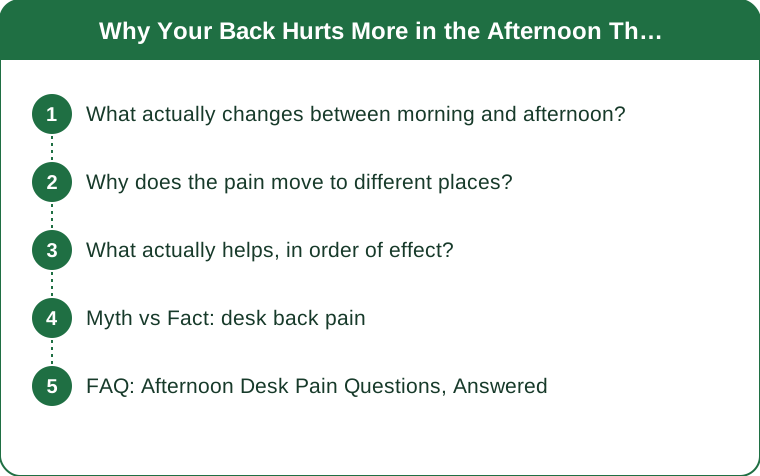
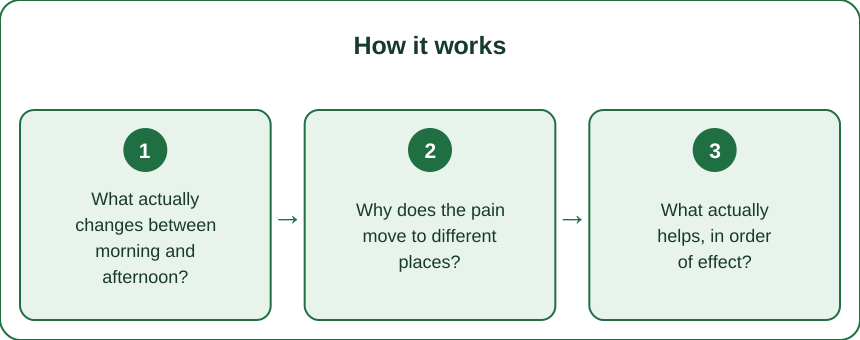
What actually changes between morning and afternoon?
Three separate processes, all running in the same direction.
Disc hydration falls. Intervertebral discs absorb fluid overnight when you lie down and lose it under compression through the day. You are measurably taller in the morning — typically 1-2cm — and the discs are at their most cushioned. By afternoon they are compressed and the load transfers more directly to the surrounding structures.
Deep stabilisers fatigue. The small muscles that maintain spinal position — multifidus, transversus abdominis — are endurance muscles, and static sitting asks them to hold one position continuously. They start giving up somewhere around the two to three hour mark, and the larger, more superficial muscles take over. Those muscles are not built for it and complain.
Posture degrades without you noticing. Everyone starts the day upright. By hour four the head has drifted forward, the pelvis has rolled back, and the lumbar curve has flattened. A forward head position adds roughly four to five kilos of effective load per inch of drift to the neck and upper back.
None of this is damage. All of it is load accumulating faster than the body’s ability to redistribute it.
Why does the pain move to different places?
Because different structures fail at different points in the sequence, and the location tells you where you are in it.
Low back, dull and central. The most common. Usually a flattened lumbar curve and sustained disc compression. Appears mid-afternoon, eases within minutes of standing.
Low back on one side. Often an asymmetry in the setup — a monitor slightly off-centre, a mouse reached for repeatedly, a leg crossed the same way. Look at what is asymmetric on your desk before assuming anything about your body.
Between the shoulder blades. The upper back version, driven by forward head and rounded shoulders. This one tends to arrive earlier than lumbar pain, often by lunchtime.
Neck and base of skull. The end stage of forward head drift, and it is the one most likely to become a headache.
Down the leg. This one is different. Pain that travels below the knee, or any numbness, tingling, or weakness, is not the cumulative-load pattern and warrants a professional assessment rather than a stretch. This is general information, not medical advice.

What actually helps, in order of effect?
1. Change position every 30-45 minutes. By a very wide margin the highest-value intervention. Not a specific better position — the change itself is the mechanism. Stand, walk to fill a glass, sit differently. Two minutes is enough.
2. Walk for five minutes at lunch. Disc nutrition depends on movement, because discs have no blood supply and rely on compression cycling to exchange fluid. Continuous sitting starves them; walking feeds them.
3. Fix the monitor height. The top of the screen at eye level. This single adjustment prevents the forward head drift that drives the upper-back and neck versions.
4. Get your feet flat and supported. Dangling feet or crossed legs pull the pelvis out of position, and everything above it compensates. A box under the desk works as well as a bought footrest.
5. Two mobility movements, mid-afternoon. A standing back extension — hands on the hips, gently arch back, ten slow reps — reverses the day’s dominant position. And a seated figure-four hip stretch, thirty seconds each side.
6. Chair adjustments, last. A better chair helps at the margin. It is genuinely sixth on this list, and it is the one people spend the most on.
Myth vs Fact: desk back pain
Myth: Sitting up straight all day is the goal. Fact: Rigidly held good posture fatigues the same muscles as slouching, just different ones. The evidence points to varied posture rather than perfect posture. The best position is the next one.
Myth: A standing desk fixes it. Fact: Standing all day produces its own set of problems — lower back, feet, and calves. Standing desks help because they enable position change, not because standing is superior. Used as a fixed all-day posture they simply move the ache.
Myth: Weak core muscles are the cause. Fact: Endurance matters more than strength here, and plenty of people with strong cores get afternoon desk pain. Sustained static loading is the driver, and heavy core training does not address it.
Myth: If it hurts you should rest it. Fact: For this pattern, movement is the treatment. Lying down at the end of a sitting day is more of the same. A twenty-minute walk after work outperforms the sofa reliably.
Myth: An expensive ergonomic chair is the solution. Fact: A good chair widens the range of comfortable positions, which is genuinely useful. It does not stop you holding one position for four hours, which is the actual problem.
FAQ: Afternoon Desk Pain Questions, Answered
Why is it worse on some days than others?
Total sitting hours, sleep quality, and stress all shift the threshold. A poor night’s sleep lowers pain tolerance measurably, so the same load registers as worse. Heavy meeting days are usually the worst because you sit continuously without micro-breaks.
Should I be worried if it wakes me at night?
Pain that wakes you, pain unrelated to position, or pain accompanied by unexplained weight loss or fever is outside this pattern. See a professional. Cumulative postural load eases with position change and does not wake people.
How long until changes make a difference?
Position-change habits usually produce noticeable improvement within one to two weeks. If nothing has changed after a month of genuinely breaking up your sitting, the cause is likely something other than static loading and is worth getting assessed.
TL;DR:
- Discs lose fluid through the day, deep stabilisers fatigue after two to three hours, and posture drifts from about hour four.
- The location of the ache tells you where you are in that sequence; pain below the knee is a different problem entirely.
- Changing position every 30-45 minutes is the highest-value fix, well ahead of any equipment.
- Monitor top at eye level and feet flat and supported prevent the two most common drift patterns.
- Movement is the treatment, not rest — a walk after work beats the sofa.
A better chair is sixth on the list and usually first on the shopping list. This is general information, not medical advice — persistent or radiating pain deserves a proper assessment.
Keep Reading
This article is for general informational purposes only and is not medical advice. Always consult a qualified health professional for guidance specific to you.