Why Your Body Hurts More the First Few Weeks of a Standing Desk
Quick Answer: New standing desk discomfort, especially in the feet, lower back, and legs, is common in the first 1-3 weeks because standing engages different postural muscles than sitting, and those muscles need time to build endurance — a gradual increase in standing time (rather than standing all day immediately) meaningfully reduces this adjustment discomfort.
The pain isn’t a sign standing desks don’t work for you — it’s usually a sign the transition happened faster than your postural muscles could adapt.

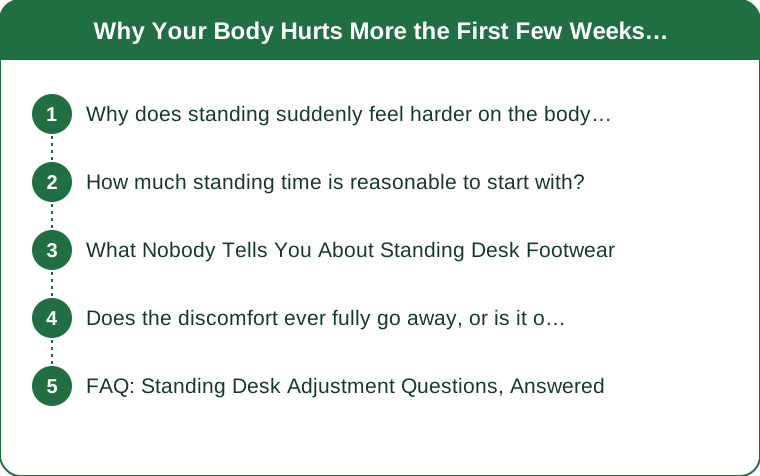
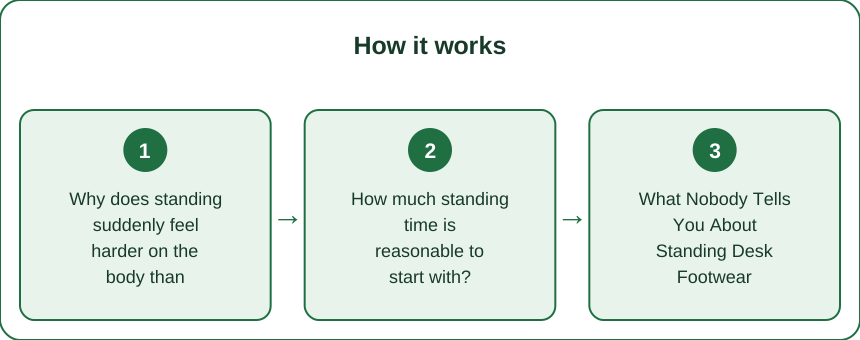
Why does standing suddenly feel harder on the body than sitting?
Sitting relies heavily on chair and backrest support, while standing requires continuous, low-level engagement from postural muscles in the feet, calves, and lower back that simply aren’t used to sustained activation — those muscles fatigue during the adjustment period the same way any undertrained muscle group would.
How much standing time is reasonable to start with?
Most ergonomics guidance suggests starting with 30-60 minutes of standing per day, spread across a few short sessions rather than one long block, then gradually increasing by 15-30 minutes every few days as tolerance builds — jumping straight to standing all day is the most common cause of the sharper adjustment pain people report.

What Nobody Tells You About Standing Desk Footwear
Standing on a hard office floor in unsupportive shoes (or barefoot on hard flooring) significantly increases foot and lower back discomfort during the adjustment period — a cushioned anti-fatigue mat and supportive footwear reduce this considerably and are often the missing piece when people say standing ‘just isn’t for them.‘
Does the discomfort ever fully go away, or is it ongoing?
For most people, the sharper adjustment-period discomfort resolves within 2-4 weeks as postural muscles build endurance, after which many report standing feels notably more comfortable than the first days — persistent pain beyond that window is more likely tied to desk height, mat quality, or an underlying issue worth addressing directly.
FAQ: Standing Desk Adjustment Questions, Answered
How do I know if my standing desk height is actually correct?
Elbows should rest at roughly a 90-degree angle with forearms parallel to the desk surface, and the monitor top should be at or just below eye level — an incorrect height can create or worsen discomfort regardless of adjustment period.
Should I alternate sitting and standing throughout the day?
Yes — most ergonomic guidance favors alternating rather than standing continuously all day, since continuous standing has its own fatigue and circulation considerations.
When should adjustment-period pain be checked by a professional instead of waited out?
Sharp, radiating, or worsening pain (rather than general muscle fatigue that improves with rest) warrants a professional look rather than assuming it’s just adjustment. This is general information, not medical advice.
TL;DR:
- Standing desk discomfort in the first weeks usually reflects undertrained postural muscles, not desk incompatibility
- Starting with 30-60 minutes daily and increasing gradually reduces adjustment pain significantly
- An anti-fatigue mat and supportive shoes address a major, often-overlooked discomfort source
- Most adjustment discomfort resolves within 2-4 weeks of gradual, consistent use
This is general information, not medical advice — pain that worsens or doesn’t improve with gradual adjustment is worth a professional look.
Keep Reading
This article is for general informational purposes only and is not medical advice. Always consult a qualified health professional for guidance specific to you.