Why Your Ankles Are Puffy by 4pm at a Desk Job
Quick Answer: Blood returns from the legs largely because calf muscle contraction squeezes the veins - the calf muscle pump. Sitting still switches that pump off, so fluid accumulates in the lower legs through the day. The most effective fixes are frequent calf pumps and ankle circles, standing or walking briefly every 30 to 45 minutes, and elevating the legs in the evening. Persistent one-sided swelling, or swelling with pain, warmth, or breathlessness, needs medical attention rather than ergonomics.
Shoes that fit in the morning are tight by mid-afternoon, and there is a sock line around your ankle at the end of the day. This is extremely common, mechanically straightforward, and largely fixable with movements that take fifteen seconds.
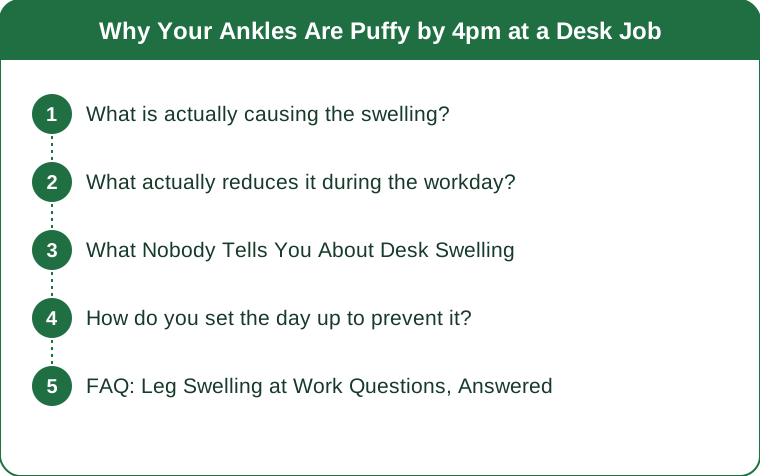
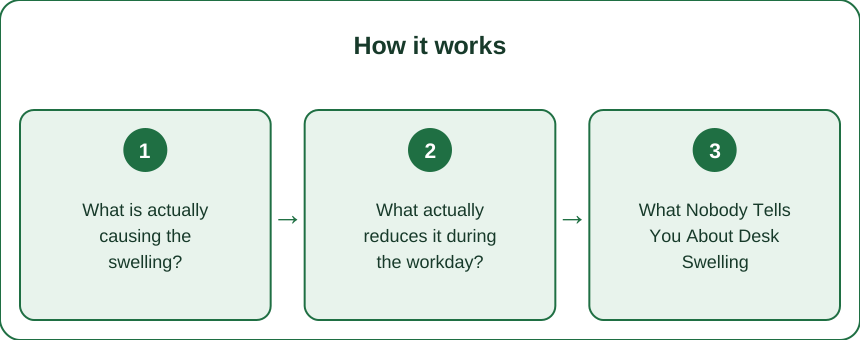
What is actually causing the swelling?
Gravity plus a switched-off pump.
Veins in the legs move blood upward against gravity, and they cannot do it on pressure from the heart alone. They rely primarily on the calf muscle pump: when the calf contracts, it squeezes the deep veins, pushing blood upward, and one-way valves prevent it flowing back down. Walking activates this with every step.
Sitting still switches it off. With the calf inactive for hours, venous return from the legs slows considerably. Pressure rises in the small vessels at the far end of the circuit, and fluid moves out of the capillaries into surrounding tissue. That fluid is the swelling - it is not water you drank, it is plasma that has left the vessels because pressure downstream rose.
Knee and hip angle contribute. Sitting with hips and knees at 90 degrees creates a mild mechanical restriction at the crease of the hip and behind the knee. Crossing the legs adds compression at the point of crossing, which is why the crossed-over leg often swells more.
Heat makes it worse. Blood vessels dilate in warm conditions, which increases the tendency for fluid to move into tissue. This is why the problem is noticeably worse in late summer and in warm offices, and why the same job in February produces less swelling.
And several ordinary factors amplify it: high salt intake, hormonal fluctuations across the menstrual cycle, some medications including certain blood pressure drugs, pregnancy, and long-haul travel the previous day. None of these are the mechanism - they all act on the same one. This is general information, not medical advice.
What actually reduces it during the workday?
Movements that switch the calf pump back on. They are small, and frequency matters far more than duration.
Calf pumps - the single most effective thing. Sitting or standing, lift both heels off the floor, hold a second, lower. 20 repetitions, every 30 to 45 minutes. This directly activates the muscle pump and takes about 20 seconds. It is the closest thing to a specific treatment for this specific problem, and it can be done in a meeting without anyone noticing.
Ankle circles and pointing. 10 circles each direction, each foot, plus 10 point-and-flex. Moves fluid through the ankle and maintains mobility in a joint that stiffens with sustained sitting.
Stand up every 30 to 45 minutes, even for 30 seconds. Standing alone helps less than walking, but it changes hip and knee angle and allows the calf to load.
Walk for two minutes every hour if you can. Two minutes of walking does more than ten minutes of standing, because the pump requires contraction and relaxation cycles, not just being upright.
Uncross your legs, and if you habitually cross, alternate which leg is on top.
Elevate at lunch if possible. Ten minutes with feet up on a chair or box lets gravity work in your favour for once.
And the evening matters: 15 minutes with legs elevated above heart level - lying on the floor with calves on a sofa is the easiest version - substantially reduces overnight residual swelling and means you start the next day from a better baseline.
What Nobody Tells You About Desk Swelling
Drinking less water makes it worse, not better. The intuition is that swelling means too much fluid, so people restrict water. Mild dehydration prompts the body to retain sodium and water, which increases the tendency to swell. Adequate hydration is part of the fix, not the cause.
A standing desk alone does not solve it and can make it worse. Standing still is also a poor activator of the calf pump - static standing has its own association with lower leg swelling and discomfort. The variable that matters is movement, not posture, which is why people who switch to a standing desk and stand motionless are often disappointed.
Compression socks are genuinely effective and underused. Graduated compression socks are well established for reducing lower leg swelling from prolonged sitting or standing, and modern ones are indistinguishable from ordinary socks. For anyone whose job involves eight hours seated, they are among the highest-value interventions available.
Salt intake shows up the next day. A high-salt dinner produces noticeably more swelling during the following workday. If the swelling varies substantially day to day with the same job, look at the previous evening’s food before blaming the chair.
And one-sided swelling is a different question entirely. Bilateral swelling that develops through the day and resolves overnight is the common pattern described here. Swelling in one leg only, particularly with pain, warmth, redness, or calf tenderness, can indicate a blood clot and requires urgent medical assessment - as does any swelling accompanied by breathlessness or chest discomfort. This distinction is the most important thing in this article. This is general information, not medical advice.
How do you set the day up to prevent it?
Structural changes that reduce the total sitting-still load, rather than relying on remembering.
Attach movement to existing triggers. Calf pumps every time you send an email with an attachment, ankle circles every time a meeting starts, stand every time you take a call. Habit-stacking works far better than a timer people learn to dismiss.
Set a genuine recurring reminder if triggers do not work - every 45 minutes, with the reminder text naming the specific action rather than saying move.
Adjust the chair so your feet are flat and supported. Feet dangling with pressure at the back of the thigh compresses the vessels there and worsens pooling. A footrest solves this cheaply if the chair cannot go low enough.
Keep the knee angle slightly more open than 90 degrees where the desk allows - roughly 100 to 110 degrees reduces the crease at the hip and behind the knee.
Consider graduated compression socks for long days, flights, or any day you know will involve minimal movement.
Address the evening. Legs elevated for 15 minutes, a short walk after dinner, and moderate salt all reduce the baseline you begin the next day with.
And if it persists despite all of this, get it looked at. Chronic venous insufficiency, thyroid conditions, kidney and heart issues, and medication side effects all cause leg swelling, and all are worth identifying. Swelling that does not resolve overnight, is new and unexplained, or is worsening over weeks warrants a medical opinion rather than a better footrest. This is general information, not medical advice.
FAQ: Leg Swelling at Work Questions, Answered
Why do my feet swell when I sit at a desk all day?
Blood return from the legs depends heavily on the calf muscle pump, which only works when the calf contracts. Sitting still switches it off, pressure rises in the small vessels of the lower leg, and fluid moves into the surrounding tissue.
Do compression socks help with desk job swelling?
Yes. Graduated compression supports venous return and is well established for reducing lower leg swelling from prolonged sitting or standing. Modern versions look like ordinary socks, which removes the main objection people have to them.
Should I drink less water if my ankles swell?
No. Mild dehydration prompts sodium and water retention, which tends to increase swelling. Adequate hydration and moderate salt intake are both part of managing it.
When is leg swelling something to worry about?
Swelling in one leg only, especially with pain, warmth, redness, or calf tenderness, needs urgent assessment as it can indicate a clot. So does swelling with breathlessness or chest discomfort. Swelling that does not settle overnight, is new and unexplained, or is worsening over weeks also warrants a medical opinion. This is general information, not medical advice.
TL;DR:
- The calf muscle pump drives blood out of the legs, and sitting still switches it off.
- 20 calf pumps every 30 to 45 minutes is the highest-return fix and takes 20 seconds.
- Standing still is not much better than sitting still - movement is the variable, not posture.
- Compression socks are genuinely effective and now look like ordinary socks.
- One-sided swelling, or swelling with pain, warmth, or breathlessness, is a medical question, not an ergonomics one.
It is not your chair and it is not your water intake. It is a pump that only turns on when your calf moves, and it has been off since 9am.
Keep Reading
This article is for general informational purposes only and is not medical advice. Always consult a qualified health professional for guidance specific to you.