Why Your Desk Pain Is Worse on the Days You Sit Most Still
Quick Answer: Prolonged stillness — not sitting itself — is the main driver of desk pain, because the same muscles stay under sustained tension without the brief resets that even small shifts in position provide. Days packed with back-to-back meetings or deep-focus work with zero movement breaks are the worst offenders.
It seems backwards: the day you barely left your desk should be the easy one on your body, and the day full of walking to meetings should be harder. Pain patterns usually run the opposite direction, and there’s a clear reason why.

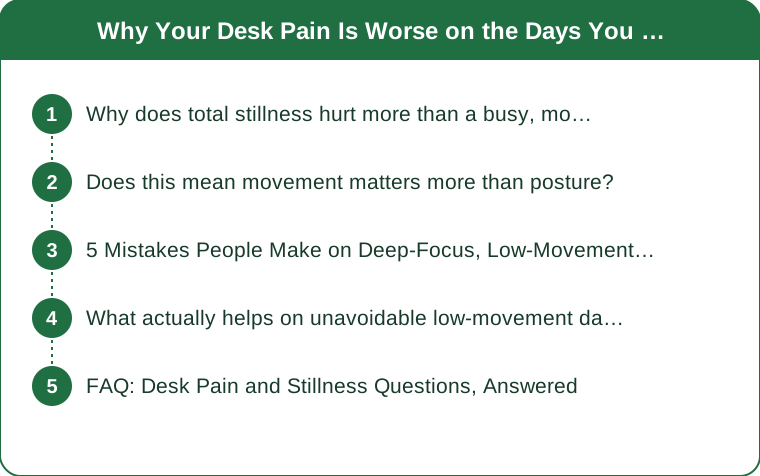
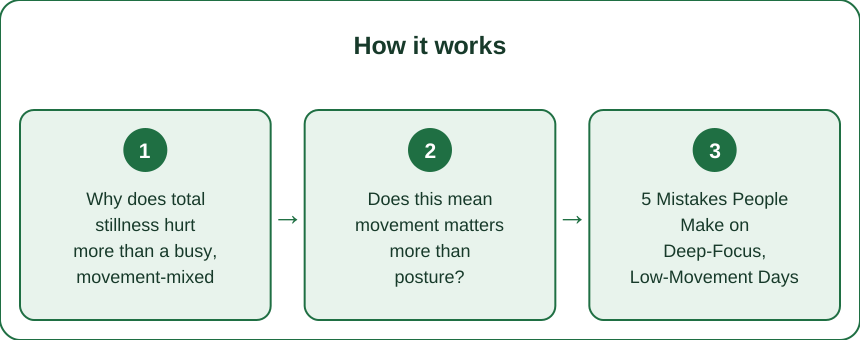
Why does total stillness hurt more than a busy, movement-mixed day?
Static muscle tension — holding the same posture without any position shifts means the same muscle fibers stay under sustained load the entire time, cutting off the brief blood flow resets that even small movements provide.
A day with several short walks between meetings gives those same muscles repeated micro-breaks, even if the total sitting time ends up similar.
Does this mean movement matters more than posture?
For pain specifically, frequency of position change matters more than finding one perfect posture — no single seated position is sustainable for hours without some kind of shift, no matter how ergonomically ideal it looks.
This is why the 20-minute movement guideline exists — it’s targeting the stillness problem directly, not chasing a mythical perfect sitting posture.

5 Mistakes People Make on Deep-Focus, Low-Movement Days
1. Scheduling back-to-back deep work blocks with zero built-in transition breaks between them.
2. Treating a good chair as a substitute for movement, when even the best ergonomic setup doesn’t eliminate the need for position changes.
3. Not noticing they haven’t stood up in 2+ hours until pain is already present, rather than catching it earlier.
4. Assuming a calm, quiet workday should feel easier on the body than a busy one, which sets up confusion when pain shows up anyway.
5. Skipping stretch breaks specifically on the busiest deep-focus days, exactly when they’re most needed.
What actually helps on unavoidable low-movement days?
A recurring timer for a 60-90 second position shift every 20-30 minutes — standing, a few shoulder rolls, or just walking to refill water — breaks the sustained-tension pattern without requiring a full break from focus.
Deliberately varying seated posture within the chair (leaning back, then forward, shifting weight) every 15 minutes or so also helps when actually standing up isn’t practical mid-task.
FAQ: Desk Pain and Stillness Questions, Answered
Why does my back hurt more after a quiet desk day than a busy one?
Sustained stillness keeps the same muscles under continuous tension, while a busier day naturally provides movement breaks between activities that reset that tension.
Does a better ergonomic chair fix this stillness problem?
A good chair helps with support, but it doesn’t replace the need for periodic position changes — stillness itself is the variable that needs addressing.
How often should I actually change position during deep focus work?
A shift every 20-30 minutes — even something as small as standing briefly or adjusting your seated posture — is enough to break the sustained-tension pattern.
TL;DR:
- Stillness, not sitting itself, drives most desk pain through sustained muscle tension
- Frequency of position change matters more than finding one perfect posture
- Deep-focus, low-movement days are the highest-risk days, not the easiest ones
- A position shift every 20-30 minutes breaks the pattern without derailing focus
The quietest workday on your calendar can be the hardest one on your back — movement, not posture, is the variable actually worth fixing.
Keep Reading
This article is for general informational purposes only and is not medical advice. Always consult a qualified health professional for guidance specific to you.