Why Your Desk Pain Came Back Worse After Vacation
Quick Answer: Time off does not deteriorate your tissues — it changes your tolerance calibration. A week of varied movement resets your body’s adaptation to sustained sitting, so the first day back delivers a load your system is no longer accustomed to. Add a lower-quality travel or hotel setup, a big single-day catch-up workload, and disrupted sleep, and the first day back is genuinely a harder day than any day before you left.
You spent a week walking, sleeping well, and not sitting for eight hours. You came back expecting to feel better.
Day one back and your neck is worse than it has been since spring. It is not in your head, and it is not that the vacation failed.

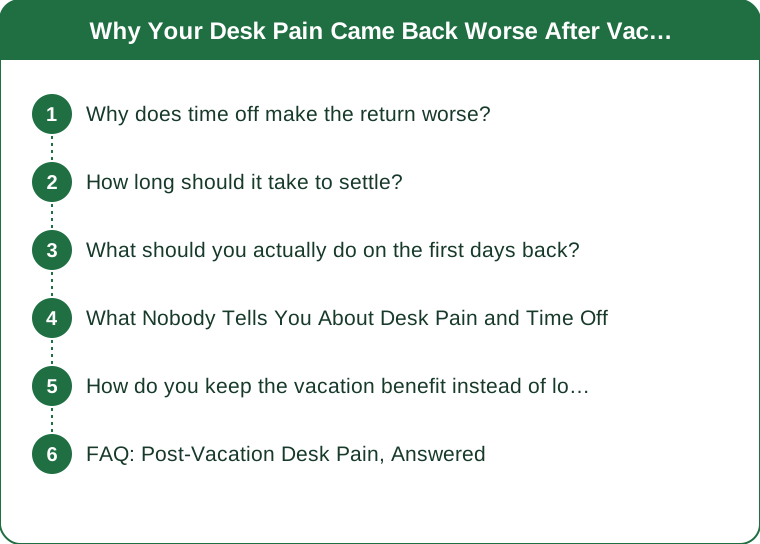
Why does time off make the return worse?
Three mechanisms stack, and each one is real on its own.
1. Tolerance is adaptive, and it decays quickly. Your tissues adapt to whatever you do repeatedly, including sitting. Someone who sits eight hours a day has built a specific tolerance for that posture — the muscles that hold it, the circulation pattern that supports it, and the nervous system’s threshold for what registers as discomfort. Take a week off and that specific tolerance drops measurably. The load has not changed; your accommodation to it has.
This is the same reason the first week back at the gym after a break is disproportionately sore. It is not damage. It is a system meeting an input it has stopped expecting.
2. The first day back is not a normal day. Most people return to a backlog. That means a longer sitting stretch, fewer breaks, more concentrated screen time, and often a skipped lunch. You did not return to your baseline load. You returned to significantly above it — on a body less adapted than it was two weeks ago. Both variables moved the wrong direction at once.
3. Vacation itself may have contributed. Long flights, car journeys, unfamiliar mattresses, heavy bags on one shoulder, and hours of walking in unsupportive shoes all load the body in new ways. Some of what you feel on day one may have started three days before you got home and only surfaced when you sat still long enough to notice.
The encouraging part: all three of these resolve on their own timeline, and the first two resolve fast.
How long should it take to settle?
Two to four days for most people, if the return is otherwise normal.
The tolerance loss from a week off is small and rebuilds quickly, because re-adaptation is faster than initial adaptation. By day three or four of a normal schedule, most people are back to their previous baseline.
Signs it is following the expected pattern:
- Worst on day one, noticeably better by day three
- Discomfort is diffuse and postural rather than sharp or specific
- It eases with movement and worsens with sustained stillness
- No numbness, tingling, or weakness anywhere
- Both sides are roughly similar
Signs it is something else:
- No improvement after a week of normal routine
- Getting worse day over day rather than better
- Sharp, localized, or radiating pain, particularly down an arm or leg
- Numbness, pins and needles, or weakness in the hands or feet
- Pain that wakes you at night or is at its worst first thing in the morning
- Only one side, in a specific spot, following an incident on the trip
That second list is not a longer version of the first — it points at different mechanisms and is worth a professional assessment rather than patience. Numbness and weakness in particular should not be waited out. This is general information, not medical advice.
What should you actually do on the first days back?
The instinct is to push through and clear the backlog. That is the one approach that reliably extends the bad stretch.
Day one — halve the interval between movement breaks. If you normally move every hour, move every 30 minutes. If you normally move every 30, move every 15. This single change does more than any stretch. You are compensating for reduced tolerance by reducing continuous exposure, which is exactly the right lever.
Reset your workstation before you sit down, not after it hurts. Monitor height, chair height, and keyboard position all drift, and someone else may have used the space. Two minutes of setup on the first morning prevents a week of accumulated poor position. Screen top at roughly eye level, elbows near 90 degrees, feet flat.
Do not try to clear the whole backlog on day one. The volume is the actual load here. Spreading the catch-up across three days instead of one is a physical decision, not just a scheduling one.
Keep some of the vacation movement. Whatever you were doing on holiday — walking after meals, stretching in the morning, being outside — keep one piece of it. This is the highest-value habit transfer available, and almost nobody does it because vacation habits feel like they belong to vacation.
Warm up before the workday, briefly. Five minutes of shoulder rolls, thoracic rotations, hip openers, and neck movement before you sit. It seems trivial and it measurably changes how the first two hours feel.
Sleep is doing more than you think. Travel disrupts sleep, and poor sleep raises pain sensitivity substantially and independently. If you got home late from a trip, some of day one is a sleep problem wearing a back-pain costume.

What Nobody Tells You About Desk Pain and Time Off
The vacation was not wasted. People conclude that a week off “did nothing” because day one back was bad. The recovery benefit is real; it is simply invisible underneath a day that combined lower tolerance with higher load. Compare week two back to week two before the trip, not day one to day one.
Feeling worse after rest is common and counterintuitive. It happens with backs, knees, and shoulders alike, and it fools a lot of people into thinking they are getting worse when they are actually less adapted, not more damaged.
The best predictor of a bad day one is the flight or drive home. A long journey the day before returning to work stacks travel loading, sleep disruption, and reduced movement immediately before a heavy sitting day. Coming home a day early to have a buffer day genuinely changes how the week goes.
Hotel pillows create neck pain that surfaces days later. A week on the wrong pillow height loads the neck in a sustained way, and the resulting stiffness often peaks after you get home. If your neck specifically is the problem, look at where you slept, not just where you sit.
Your desk pain probably was not “gone” on vacation — it was masked by movement. Frequent varied movement suppresses this kind of discomfort effectively. That is useful information: it tells you movement frequency is your most powerful lever, which is exactly what to apply at your desk.
A slightly worse setup with more movement beats a perfect setup with none. Ergonomics matters, but movement frequency matters more, and people consistently over-invest in the chair and under-invest in the timer.
How do you keep the vacation benefit instead of losing it in a week?
The goal is not to recreate vacation. It is to identify which single element was doing the work and keep that one.
Figure out what actually helped. For most people it is one of four things: walking a lot more, sitting far less continuously, sleeping better, or lower stress. It is worth being honest about which one, because they call for different responses.
- If it was walking: add a genuine 20-minute walk on workdays, ideally at midday. This is the most transferable of the four.
- If it was reduced continuous sitting: the fix is a timer, not a new chair. Every 30 minutes, stand for one minute. Set it and let it interrupt you.
- If it was sleep: protect the sleep window on work nights the way you did on holiday. Pain sensitivity and sleep are tightly linked, and this one is frequently underestimated.
- If it was stress: that is a harder problem and worth naming honestly rather than solving with a lumbar cushion. Muscle tension from sustained stress produces genuine, physical desk pain.
Build one buffer habit for the transition. Take the last afternoon of any trip off from travel, or plan a lighter first day back. Even a half-day first day changes the trajectory of the week substantially.
And plan the next return. Now that you know day one is predictably the worst day, you can schedule around it — fewer meetings, more breaks, no marathon sitting stretch. Most of the misery is avoidable once you stop being surprised by it.
FAQ: Post-Vacation Desk Pain, Answered
Should I stretch more or move more?
Move more. Frequency of position change does considerably more for sustained-posture discomfort than any stretching routine. Stretching feels good and is worth doing; it is not the main lever.
Is it bad that a week off made me weaker?
You did not get weaker in any meaningful sense — you lost some specific adaptation to sitting, which rebuilds in days. Actual strength loss takes much longer than a week to show up.
Should I take painkillers to get through the first days?
That is a conversation for a pharmacist or clinician, particularly regarding your own health history. Non-pharmacological levers — shorter sitting intervals, a lighter first day, a warm-up — address the cause rather than the sensation, and they are worth doing regardless.
How do I stop this happening next time?
Build a buffer day between travel and work, spread the backlog over several days, and halve your movement interval for the first three days back. Those three changes handle most of it.
TL;DR: Desk pain after vacation is a tolerance recalibration, not a setback.
- Sitting tolerance is adaptive and decays in about a week. Same load, less accommodation.
- Day one back is above baseline, not at it — the backlog means longer sitting and fewer breaks on a less-adapted body.
- Travel itself contributes: flights, hotel pillows, and one-shoulder bags all load you before you ever sat down.
- Expect two to four days to settle. Worse after a week, or any numbness or weakness, is a different problem.
- Halve your movement interval for the first three days. It outperforms every stretch and every gadget.
- Keep one vacation habit — usually walking or sleep — rather than trying to keep all of them.
Set a 30-minute timer on your first morning back. That is the whole intervention, and it works.
Keep Reading
This article is for general informational purposes only and is not medical advice. Always consult a qualified health professional for guidance specific to you.